During this weekend's Boston-Minnesota series there was another Joe West kerfuffle and the play-by-play guys brought up Joe West's history with Boston. They mentioned West's comments last year that he did not like the Boston Red Sox and New York Yankee style of play, particularly those teams' long games. Setting aside one's own opinion game length and how appropriate it is for an umpire to criticize particular teams, I am sure that umpires — like everyone else — notice when games drag on. But unlike everyone else they are in a unique position to do something about it. So based on West's comments I wondered whether umpires expand the strike zone during long games to speed things along.
To look at this I used the, conveniently time-stamped, pitchf/x data. I collected all pitches made in the sixth through eighth innings and the looked at how long into the game each was made. For example, the average pitch in the sixth inning was made 1 hour and 48 minutes after the start of the game. Then I formed two subsets of these pitches, those in the top 5% of length for their half inning, and those in the bottom 5% of length for their half inning. For example the 'long' group included pitches from the bottom of the eighth inning that were thrown 3 hours and 14 minutes or more after the game started. Pitches from the bottom of the eighth inning were included in the 'short' group if they were thrown before 2 hours and 1 minute since the game started. And similarly for other half innings. The top and bottom of the inning were done separately so that pitches from the top of innings didn't over represent in the 'short' group and bottom of the inning pitches in the 'long' group.
So these pitches come from situations where the game has already gone on for a very long or short time when they were thrown. Now we are interested in how the strike zone was called on these two groups. Unfortunately there might already be a sampling bias in the data. 'Long' games might have umps with smaller strike zones, that being why the game has gone on so long. So a more clever WOWY approach would be preferential, but I couldn't come up with one.
With that limitation in mind let's see how the strike zones of the two groups compared. To first see how the top and bottom of the zone were called I considered taken pitches that were clearly in the zone horizontally ( -0.5 > px < 0.5), and looked at their called strike rate by normalized pitch height.
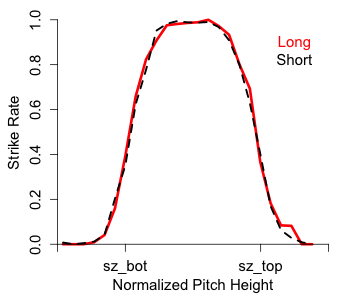
Effectively no difference. The top and bottom of the zone were called at close to the same spot for both samples of pitches (and very close to sz_bot and sz_top, showing that the stringers do a pretty good job with these values).
Turning to the horizontal zone I similarly looked at pitches that were clearly in the zone vertically (pz in the middle half of the interval between sz_top and
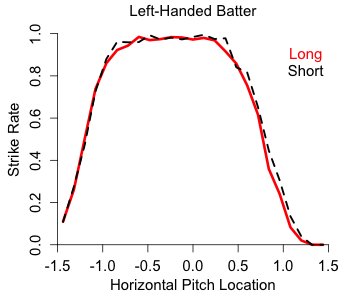
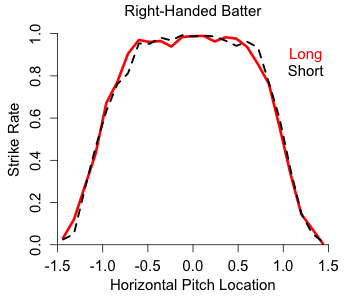
Again there is almost no difference. And if anything there is a very slight difference on the right edge of the zone (from the umpire's perspective), with the 'long' zone slightly smaller. The opposite effect if the umpire was trying speed the game up. Although the difference is tiny.
So overall, at least by this methodology, there is no difference in how the zone is called in long versus short games. If the umpires are annoyed by having to call a game going into its third hour in the seventh inning they don't seem to let it affect their strike zone. Score one for the boys in blue.
Source: http://baseballanalysts.com/archives/2011/05/does_the_ump_ca.php
arkansas razorbacks baseball baseball backstops 2009 world series baseball alabama baseball

No comments:
Post a Comment